Reprinted from Museum Interactive Multimedia 1997: Cultural Heritage Systems Design and Interfaces, Selected Papers from ICHIM 97, The Fourth International Confrerence on Hypermedia and Interactivity in Museums,edited by David Bearman and Jennifer Trant, 1997, pp 199-211. http://www.archimuse.com:Archives & Museum Informatics, 1997, pp 199-211.
The Fourth Wall The Virtual in the Museum, Re-U-Man, Udi Aloni, 1996 http://www.re-u-man Susan Hazan, The Israel Museum, Jerusalem
This trend followed the relatively recent establishment of video as an accepted medium of original art and the current popularity of video art in art museums. Video and television technologies were originally limited to television stations with the facilities and capabilities to work in this medium. Television companies mainly focused on popular and documentary productions but as technologies developed, and as artists gained access to portable cameras, video players, etc. they began experimenting with new creative possibilities. As visitors, we are no longer surprised to meet a Bill Viola or Tony Oursler using a television or monitor in installations and we rarely relate to the fact that there is a monitor there at all. There is a seemless-ness and transparency about the medium that doesn't distract us from the art experience. As the World Wide Web expands as present trends show, and artists begin to understand more and more about this medium, we are bound to see an explosive increase of web-sites (as the 'real' art work) appearing all over the world. When these sites are deemed appropriate to show at an art museum, the curator will have to find ways to exhibit the art on suitable monitors in the gallery. If access to these web-sites from within the gallery floor is identical to the access from beyond the museum, what will entice the visitor into the museum to see the 'collections' at all? Would the visitor bother to come to the museum to witness a television broadcast while he could equally well enjoy it from the comfort of his own home? In the short space of this paper, I am afraid that I will only be able to pose these questions but not necessarily answer them. New digital art works are appearing all over the world and it has become clear not only that they are already having an impact on how we perceive of the art museum and the containing space that the four walls traditionally enclose, but also on the way curators produce their collections, be them real or virtual. With virtual exhibitions on-line, original digital art flowing into our home computers at the click of a mouse and now entire original art collections becoming available beyond the fourth wall, why does the visitor need to even come into the real museum? In November, 1996, Udi Aloni exhibited an interactive digital work at an installation at the Photography Gallery of the Israel Museum, Jerusalem, "Re-U-Man", which had been previously inaugurated at a presentation at the Metropolitan Museum of Art, New York, June -25 21,1996.
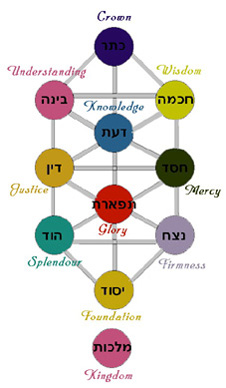
Aloni's canons of the secular and non-secular, combined with his powerful erotic imagery, create a compelling protocol that flows in virtual space and requires several hours of the visitor's time to travel, retrieve and combine. In post-modern tradition, Aloni eclectively incorporates text, gnostic writings, the New Testament and the Bible, combines and blurs sexual identity, and calls on personal and collective mythology. Through this manipulation of digital information, imagery, and audio narrative, Aloni has found an efficient vehicle to help him/us merge the scattered pieces, a self-appointed task that he has set for himself, in a bid to recreate the new human, Re-U-Man. The 'Tree of Life' motif is a logical, visual and conceptual framework for his re-assemblance of the divine sparks, but not a motif that is often found in Jewish iconography. This is due to the fact that traditionally, the Kabbalistic esoteric knowledge, found in the Book called the 'Zohar', should not be read carelessly. The 'Zohar', (the Book of Splendour), appeared in Catalonia, Spain, in the 13rd century and throughout the centuries, these sources have not been readily available to all, but have been concealed and protected by Kabbalistic scholars. The 'Zohar' is purported to contain such powerful knowledge that the unworthy may well endanger themselves if not properly equipped to receive it. Traditionally, the 'Talmud' stipulated that only men over 40 years of age, married, and steeped in the wisdom of the Talmud could attempt to study the 'Zohar'. The implication was that one should be mature, stable and anchored in Jewish tradition. Rarely have Jewish artists selected the 'Tree of Life' motif for their art. There is a Jewish taboo of representation of God's image in any visual form and throughout the centuries very few exceptions have been found. A rare exception is evident in a Jewish marriage certificate, ('Ketubah') from Mantua, dated 1689, from the collection of the Jewish Theological Seminary of America where there are several winged creatures in vignettes on the borders which appear to be anthropomorphic representations of God. On rare occasions we do find visual references to God, depicted as a hand appearing behind a cloud, as noted above the altar on the sacrifice of Isaac on the mural in the Dura Europus Synagogue, Syria, from the third century CE and in the wall painting at the Beit Alpha Synagogue, in Israel, sixth century CE. Kabbalistic iconography has similarly been taboo for Jewish artists and craftsman and very few exceptions of secular art depict the 'The Tree of Life' or other Kabbalistic iconography. An exception is Mordechai Ardon who has included the 'Ten Spheres' into a number of his works. As a student at the Bauhaus, he remained unaffected by the spiritual Christian influences of his contemporaries at the time, yet included Jewish motifs such as Hebrew letters and the 'Tree of Life' motif in his works after his arrival in Israel in 1933. Ardon's primary motivation was to meet the challenge presented by the fathers of the young Jewish State through the creation of a new Israeli art, anchored in the present but with roots firmly tied to the past. The 'Tree of Life' motif appears in a number of his triptychs, notably in his 'At the Gates of Jerusalem', 1967, from the collection of the Israel Museum, Jerusalem. Here the 'Tree of Life' is called 'Sign' and appears on the the right hand panel as a floating, mystical icon. Aloni has not only incorporated the 'Tree of Life' allegory into his work, (in itself a provocative choice of focus), but has interwoven within this theme, both the secular and non-secular in his journey to re-make man. This motif does makes an impressive cartographical anchor, mapping out branches and nodes both thematically and technologically, an ideal metaphor for a Kabbalistic web-site. Aloni questions gender, tradition and politics by juxtaposing his commentaries, such as the Dionysus passage, and his reference to the Jehovah myth, with secular and other political commentaries in his self-appointed Sisyphean efforts to recreate a whole. He has well benefited from his experience as gallery owner of the Bograshov Gallery in Tel Aviv, where his experience both as a curator/exhibitor has provided him with more than one perspective. It is this sense of the overview that makes the web-site so effective, where not only has Aloni created the individual artistic elements, but has in fact created the whole, an impressive accomplishment for an individual artist. The Kabballah refers to letters and numbers as being the building blocks of the universe where mysteries were encrypted into names, phrases and existing passages of scripture, and that even the earth was created by the use of these powerful words. In recent years we are witness to a renewed interest of these ancient esoteric scripts and their appearance in popular culture through surprisingly extensive exposure via electronic and traditional media . A Kabballah scholar believes that through visualisation and contemplation of holy letters and names, divine realisations become apparent. While to some, such practices would be considered magical superstition, it seems that others, such as Aloni, are interested in testing out their relevance for our post-modern culture.
The ten spheres are known as 'Sephiroth', the plural of 'Sephirah', meaning a number and are connected in prescribed ways, each identified with a letter of the Hebrew alphabet. There are several definitions and interpretations of the tree of Life from their Hebrew original, one being:
The first nine 'Sephirot' were grouped in threes, each triad including a masculine element, a feminine element, and a combining element. The first three 'Sephirot' represented the world of thought; the second, the world of emotions and morals; the third, the world of nature. The tenth and separate sephirah, 'Malchut', existed alone as the harmony of the other nine. In the Aloni digital version of this diagram, we can follow the traditional placements and connections of the ten spheres super-imposed on Aloni's naked body, pierced by numerous stigmata, self-inflicted by digital means. Each part leads us with the click of a mouse to a separate element of the commentary, combining his seemingly incongrous elements into a fascinating whole. In "Updating Sisyphus" the Sisyphean motif is evoked to include references to what Aloni calls the Jehovah myth and its similarity to the Dionysus myth. Both deal with the divine body, torn to pieces and spread all over the world. His commentaries appear here, as in all parts of his web-site, both in textual and audio narration.
When we examine what Aloni has included to his left and to his right, where reference to the right and left sides of man of the anthropomorphic model would traditionally correspond with the left and right sides of God, we find his three visual 'Midrash' (commentaries), tales of the secular, poetic and profane and his demons: In Visual Midrash I, in his passages called 'the Twin' he quotes Ecclesiastes:
His texts are superimposed on an image of a naked female model, similarly pierced with stigmata and seemingly pinned to the digital page as a butterfly would be pinned to its box. Although frozen in their stylised and inhuman poses, both the Aloni thumbnail image and his female counterpart dance from side to side in a grotesque bid to break free. In "Sham" Visual Midrash II, we are taken through lengthy narratives about such characters as Helen, a hermaphrodites hooker from Tel Aviv and Ezekiel/Simon, a kiosk owner in Ben-Yehuda Street who sells ice cream to passersby. These narratives are presented side by side with sacred texts, often creating bizarre connections and associations. Aloni sometimes provides us with the associations, at other times we are forced to conclude them for ourselves. In reference to Hanna, we are provided with a reference to Talmudic passages:
Visual Midrash III deals with 'Kadish', a series of pictorial, digitally devised remakes of the human form. Female and male figures are blended and navels and stigmata appear in unusual places. This is where Aloni has decide to include a demon of his own, with the explanation:
We are reminded of demons inhabiting Jewish literature and art for hundreds of years, and their connection to numbers and letters as in Singer's, The Last Demon: 
Under 'Malchut', Kingdom, Aloni has attempted to re-examine the political "I" with the "Left"-A Movie" a reference to modern day politics including a statement by Azmi Bishara, "Political rally, and the question: why would an Arab citizen ever vote for the Zionist Labour Party?"
While it takes a leap of faith on the readers part to integrate these political statements into the more traditional and sacred tracts, Aloni does add his own explanation:
I have included here only a very small part of Re-U-Man. In order to fully comprehend the length and breadth of Aloni's work, I would suggest that the web-site be accessed and time taken to hear Aloni's narratives in "Real Audio", both in Hebrew and in English. While Aloni's work was shown on two computers in his installation at the Israel Museum last year, amidst large wall print-outs of his images, in an area reminisce of a study corner, the compelling content of his work is readily available on-line at: It was interesting to see how well the Aloni work was received by the public at the Museum, locally installed on the computers and not on-line. Visitors often spent more than an hour at the monitor, even while the web-site was simultaneously on-line and well promoted in the traditional print and electronic media. A link from the Israel Museum web-site was created and there was clearly enough information for our visitors to be able to find the web-site from home. We had no way of knowing if our visitors had access to the Internet at home or at work or simply preferred to travel the Re-U-Man web-site from within the context of the museum gallery. What was clear was that the visitors welcomed the opportunity to travel the web-site within the context of the museum gallery. Had they come across this media for the first time or were they concerned that they wouldn't be able to find Re-U-Man if they tried to access from their computers at home? Were the more savvy surfers aware that from home it would be much more time consuming to download the numerous graphic heavy pages and quick-times, or was it deemed more appropriate to view such a work within the atmosphere and ambiance of an art museum? Presuming that conditions of access are identical at home and from the museum, (not strictly true with the Re-U-Man site), would our visitors still invest their time in an activity within the museum walls that could be readily accomplished at home? How can curators plan in the future for exhibitions that include web-sites while maintaining a discreet space for exhibiting original art works? Over the last decade, we have witnessed the birth and development of web related projects. Some are site and time specific - others take advantage of the timelessness and spacelessness of the web, in order to exploit the full fluidity of this medium. In 1984 'The Electronic Cafe International' was created, (founded in the Orwellian year of 1984) as part of the Los Angeles Olympic Arts Festival. Cafes and restaurants were linked together throughout the city and activities took place in several languages via a computer network. During seven weeks, visitors could conference over the network in video and audio and collaboratively share their simple artwork in a realtime shared-screen environment, contributing freely to a line drawing archive.
This was an impressive futuristic project for a community in 1984 while the net was still in its infancy and set a precedent for later electronic cafe projects, cybercafes, and other digital community based activities. As seen in the development of video art, this too was a technology plucked out of the laboratories and put into the hands of artists, even though, at this early stage it was heavily dependent on the technologists to make it all happen. In recent years, artists have been freed of the dependency on intense technical expertise and by using off the shelf applications, have brought digital art into the public and popular arena. Today, electronic cafes of one form or another can be found in most major cities in Europe and the U.S.A and often are the only place in the community that offer public access to the Internet. Most cafes offer e-mail access, browsing and some kind of conferencing, chat, video-conferencing etc. and are often the only public places where original digital art work may be viewed for a person who does not have a computer at home. Where are museums in this scheme of things? Should art museums offer access to other protocols on the net other than viewing art work on a browser from within the museum? In 1992, Axel Wirths, Founder and Director of media 235 MEDIA in Cologne, and founder of the first 'Mobile Electronic Cafe des Artistes; built the 'Casino Container', an experimental solution for public spaces in the media age by, what he claimed to be a redefined and extended virtual area, and purported to promote electronic nomadism as an up-coming way of life. This was a further effort to combine the real and virtual by "offering hospitality to electronic travellers" by networking cities. About 80 projects were developed in cooperation with network partners in Los Angeles, Toronto, Paris, Lyon, Helsinki, Aarhus, Cologne, Graz, Sydney, Fukui, Tokyo, and others.
Recently, a number of galleries and art museums have responded in different ways to the proliferance of art web projects. At the Dia Center for the Arts, New York, there have been many projects over 1996/97, mostly presented in conjunction with exhibitions, including such artists as: Cheryl Donegan, Molissa Fenley, Juan Muñoz, Susan Hiller, Komar & Melamid and Jessica Stockholder. In May 1995 the first site-specific web project - "Fantastic Prayers" was presented, a collaboration of writer Constance DeJong, artist Tony Oursler, and musician Stephen Vitiello. The work included text, sound, and images describing a place called Arcadia and its young residents living in a kind of idyllic Arcadian suspension.
Those who have spent time surfing the net may agree that one of the pleasures of this kind of activity is precisely this amorphous travel that allows us, at a click of a mouse, to arrange and rearrange information and images at our own pace, comparing elements that may not be connected together in non-virtual space and combining them and in new ways that have meaning for us. It is precisely this non-linear experience that Aloni had skillfully utilised in his web-site and has allowed us to make our own connections. A further aspect of the Internet, and perhaps more compelling is the opportunity to interact with the activity that we are watching, hearing or reading. As technologies become more fluid, new protocols allow user interaction in ways only dreamed of today and will reinforce the sense of community that were sought after both in 'The Electronic Cafe International' and 'Mobile Electronic Cafe des Artistes, Casino Container'. Exploiting this interactive capacity of the net, the MIT List Visual Arts Center, Cambridge, MA, PORT: Navigating Digital Culture presented 'An Investigation into Performance on the Internet'. This thematic exhibition was organised by the New York-based collaborative 'Artnetweb', and was held at the List Visual Arts Center January 25 - March 29, 1997, where the work of artists who use the Internet as their medium was presented. This ambitious project included artists, G.H. Hovagimyan, Adrianne Wortzel, Heather Wagner, Jeff Gompertz, Bruno Ricard, Emily Hartzell, Nina Sobell, Hal Eager, and Marah Rosenberg. The principal organisers of PORT were Remo Campopiano, Robbin Murphy, Marek Walczak, G.H. Hovagimyan, Adrianne Wortzel and Ebon Fisher. Visitors were invited to participate in or observe the events, either in the LVAC galleries, or from their own computer terminals outfitted with the necessary hardware and software. In the actual gallery, computer terminals and the technologies needed to participate were available for use and performances were projected onto large screens. One of their stated goals and of primary and unifying concern to the artists participating was the interactive potential of the Internet and its functions as creative catalyst, network, and social space. This was accomplished by the setting up of Listserv, and/or e-mail discussion group. The exhibition was intended to provoke questions about the identity and the role of the artist situated within a virtual terrain, and the role of an active viewer/participant, and the dematerialized work of art. Artists were given two hours per week to work at the three performance environments, The MIT List Center Gallery, the point of production, (the studio), and the home computer. The Center was the optimum point for the visitor to view the works, having a (T3) connection and perfectly tuned software and hardware configurations. This was the main advantage over viewing the works from the home computer and the justification for the visitors to come into the space. Site specific web-site exhibitions, such as the MIT project, provide an opportunity for the public, both local and remote, not only to view the art but to interact with it. They are an exciting place for new art forms to evolve and an exciting space for the visitor to feel a part of the creative process. We are all familiar with the concept of art museums and recognise them as 'containers' of original art works, an open environment where complementary or contrasting expressions of culture are placed side by side in the gallery at the whim and wisdom of the curator. We look to the curator to create refreshing and new juxtapositions of these works to provide us with further insights to our own cultural heritage and to other cultures and return again and again to renew this experience. Where once the museum gallery appeared to us rather like a room or series of rooms, or salon, with the fourth wall left invitingly open for us to venture inside and mingle with the originals and experience the beautiful, the awesome, the religious, and the profane with our own eyes, we are now visitors to another, new kind of art museum. With museums and galleries constantly redefining themselves, our expectations change as curators seek new ways to keep up with these developments. In March 1997, the Geffen Contemporary at MOCA, Los Angeles exhibited "Common Sense". This was a bid to introduce 'alien' elements into the museum, such as a rodeo, drawing classes with live models, art-making activities by "community groups" including street and maintenance workers, live theatre productions on a real bus, meetings to plan a community center in Watts, and an installation revealing an artistic collaboration with the prime-time TV show Melrose Place. In all these performances, the visitor was an active participant in the installation, and without the visitor interaction, the installation became invalid. While art galleries and museums include alien artifacts inside the galleries and digital original art forms that exist outside the museum and are piped in, both curators and visitors are going to have to deal with the changing pace and space of art museums in the near future, whether they be real or virtual. How are curators dealing with art that is sitting on a server beyond the fourth wall of the gallery? A creative and inventive way of including remote art work in a real gallery has been developed recently by Stephen Nowlin of the Williamson Gallery, Art Center College of Design, Pasadena. The virtual wing here features links to works of art created exclusively for the Internet and was at the time of writing featuring the project by the fascinating Spanish artists Joan Heemskerk and Dirk Paesmans. The site can be found at: The inviting comment at the virtual portal reads: "Please bookmark this page before entering -- you may be gone for a while".
For Nowlin to include such a project at the Williamson Gallery Virtual Wing, he is exercising his curatorial expertise in exactly the same way as he would at the real gallery: in his responsibility to select and present the art work, in the preservation of the creative integrity of the art and in providing optimal access for the visitor. Some museums are now taking on a leading role in selecting and exhibiting web-sites on line and others are sure to follow suit. The Whitney Museum of American Art is actively sponsoring artists' web projects. In addition, on this site, they provide links to artists' projects, maintained either by the artists themselves, various other institutions, or private concerns, around the world. Artist included at the Whitney site include: Laurie Anderson, Shu Lea Chang, Lowell Darling & Jim Newman, Douglas Davis, Constance DeJong, Tony Oursler and Stephen Vitiello, Felix Stephan Huber and Philip Pocock, Nam June Paik and Paul Garrin, Komar & Melamid, Tim Maul and Ben Neill, Antonio Muntadas, Andrei Roiter Julia Scher. This list does not include geographic references to the location of the web-sites and we can but wonder if this is at all relevant in the global nature of the Internet. While museum web-sites are blossoming all across the world and developed by numerous staff members at the museum, it is imperative that these virtual wings, promoting original art, be the responsibility of the curator and be perceived as extensions of the museum or gallery. While developing the virtual wing outside of the fourth wall, effort should be made to preserve the integrity, authenticity and curatorial context of the art, in much the same way as exhibitions from within the museum walls. Considering the incredible speed at which these developments are taking place, we must pause, reevaluate and redefine the museum space, be it real or virtual. Aloni's Re-U-Man, while clearly appropriate for viewing within the museum walls in 1996, only hints at the type of questions that will be raised by curators and the challenges that they will be meeting in redefining the art museum in the years to come. Susan Hazan
Bibliography - Re-U-Man Isaac Bashevis Singer, "The Last Demon", The Collected Stories, New York, McGraw-Hill Ryerson Ltd., Toronto, 1986. ISEA '94 Catalogue, The Fifth International Symposium on Electronic Art, Publication of the University of Art and Design, Helsinki, 1994 Jewish Art, Bezalel Cecil Roth, Hebrew Edition by Bezalel Narkiss, Massada Publishing, Ramat Gan, 1974, Israel. Jewish Art, Grace Cohen Grossman, Hugh Lauter Levin Associates, Inc., China , 1995 Jewish Folklore and Legend, David Goldstein, London, 1980 Ellen S. Saltman, Center for Jewish Art of the Hebrew University, 'The Forbidden Image in Jewish Art', Journal of Jewish Art, Volume Eight, Jerusalem, 1981 The Israel Museum, Editor/Project Coordinator: Irene Lewitt, Laurence King, London, 1995 Mordechai Ardon, Michele Vishat, Harry N. Abrams, Inc., Publishers, NewYork, 1975 Dia Center for the Arts first site-specific web project. Electronic Cafe ISEA Proceedings, 1994 Re-U-Man, Udi Aloni, 1996 The Whitney Guest Book Williamson Gallery, Art Center College of Design, Pasadena, The Virtual
Wing
Figures:
|